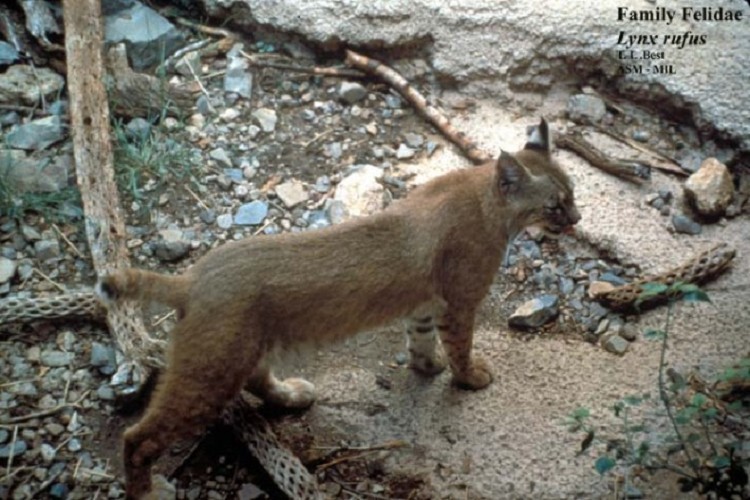
Bobcat, Lynx rufus

The Bobcat, which is a stealthy hunter aided by keen eyesight, hearing, and a well-developed sense of smell, is the most common and widely distributed wildcat in North America. It can be found all across Tennessee.
Description: A large mammal with long legs, stubby tail, broad face, short snout, and prominent pointed ears that sometimes have tufts. The short fur is tawny-colored with black spots and streaks.
Facial fur has black lines and a ruff of fur extending from the ears down to the lower jaw. The backs of the ears are solid black with a central white spot. Underparts are white with black spots. Upper legs and tail have black barring; the tail tip is black. They have sharply curved claws that can be retracted.
Length: 22.5 - 50.0 inches
Tail: 3.8 - 7.9 inches
Ears: 2.5 - 2.8 inches
Weight: 10.0 - 40.0 pounds
Similar Species: The domestic cat is smaller, has a longer tail usually, and is not spotted with black. Bobcats are often confused with cougars, although cougars are many times larger, longer, and have a very long tail.
Habitat: Bobcats occur in a variety of habitats, but they prefer heavily forested areas with thick underbrush. They also occur in timbered swamps; farmland; scrubland; and rocky terrain such as glades, bluffs, and rocky outcrops. Maternity dens are made of dry leaves and moss and usually located under a fallen tree, in a hollow log, or in a rock shelter.
Diet: The majority of food is small mammals, including rabbits, mice, rats, squirrels, and shrews. They will also occasionally eat deer, turkey, snakes, domestic cats, and grass.
Breeding information: Mating season begins in December and may continue into summer, but usually peaks in March. A litter of 1-5 (usually 2-3) kittens are born after a 50-70 day gestation period. Kittens are born with sharp claws and spotted fur.
They are able to play outside the den after their eyes open at 9-11 days old. Weaning occurs at 2 months old, but the kittens will stay with the mother until at least the fall.
Status in Tennessee: Bobcats are hunted and trapped in the state. They may be abundant in suitable habitats.